Smart-Home Simulation
Real-Time Device-to-Device Communication
Overview
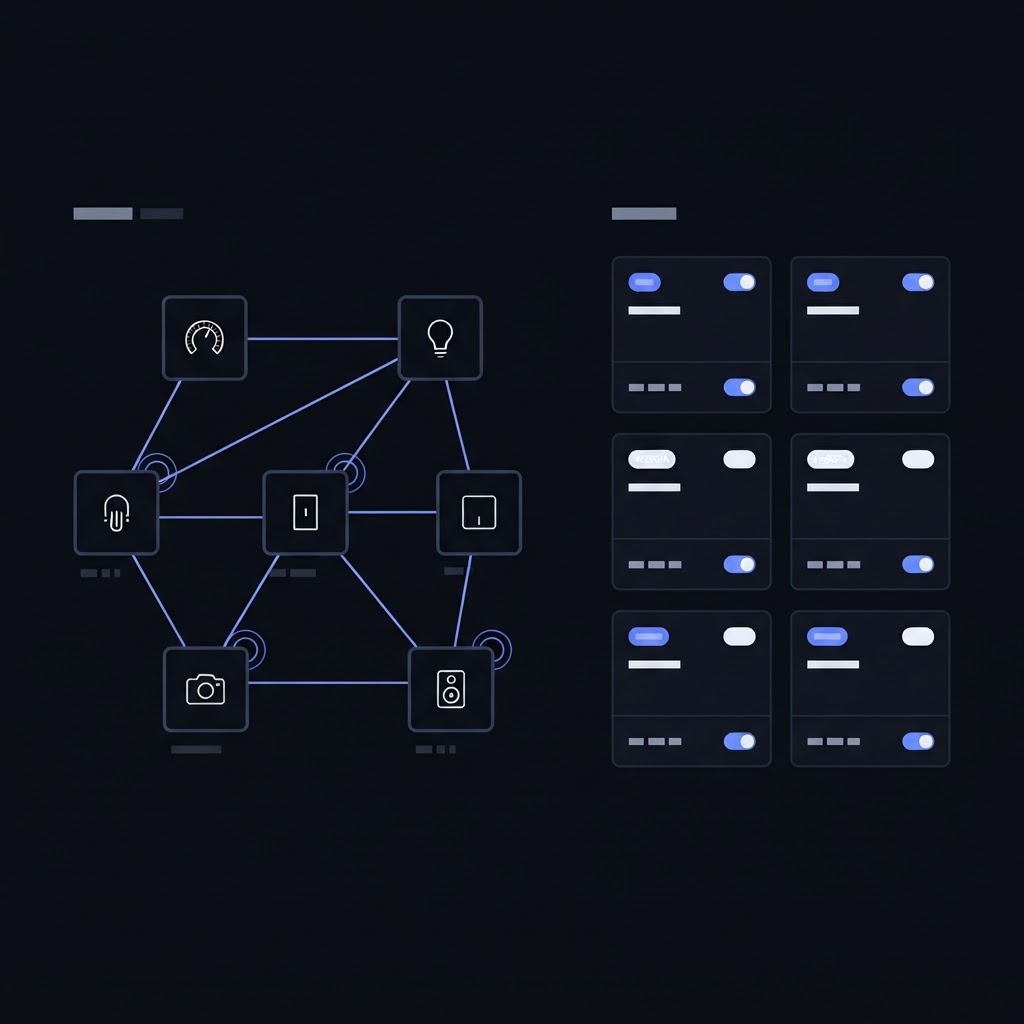
The Smart-Home Simulation is a networked application that models a connected home environment in which virtual devices communicate and respond to changes in real time. The system explores how smart-home components can exchange state information and coordinate behavior without depending entirely on a traditional centralized request-response workflow.
Using WebRTC for peer-to-peer communication, the project focuses on real-time data exchange between connected devices and the simulation of interactive smart-home scenarios.
Problem
Smart-home environments involve multiple devices that must exchange information and respond to changing conditions. Traditional centralized architectures can introduce additional communication dependencies, while disconnected device interfaces make it difficult to demonstrate coordinated behavior and immediate state updates.
A simulation offers a controlled environment for exploring communication, synchronization, and interaction between virtual devices before integrating physical hardware.
Solution
I developed a smart-home simulation in which virtual devices represent components of a connected home. Devices can exchange messages through a WebRTC-based communication layer, allowing the application to model changes in device states and interactions between connected components.
The simulation provides a foundation for experimenting with peer-to-peer communication, device coordination, and real-time event handling without requiring physical smart-home hardware.
Key features
Virtual Device Modeling
Represent smart-home components such as lights, sensors, switches, and thermostats.
Real-Time Communication
Exchange device messages using WebRTC data channels.
Device State Management
Track device states and reflect supported changes in the simulation.
Device-to-Device Interaction
Model communication between connected peers without routing every data message through a central application server.
Interactive Simulation
Trigger device actions and observe their effects within the simulated environment.
Connection Management
Handle peer connections, connection state changes, and communication failures.
Event-Driven Updates
Process incoming messages and update relevant device states in response.
Extensible Architecture
Support the addition of new virtual devices and interaction scenarios.
Implementation
The system uses WebRTC to establish peer-to-peer connections between participating clients or simulated devices. A signaling mechanism is required to exchange connection metadata and establish those connections. Depending on the network environment, STUN and TURN services may also be needed to support connectivity.
After establishing a connection, WebRTC data channels can transmit device commands, status updates, and other structured messages with low latency. The application processes incoming messages, validates their contents, and updates the relevant device state.
Because a peer-to-peer connection does not automatically provide discovery, authentication, authorization, or global state consistency, these concerns must be addressed separately where required by the simulation. A production smart-home deployment would also need appropriate security controls and reliable device identity management.
Challenges
- Establishing peer-to-peer connections and managing the signaling process.
- Handling connection lifecycle events and unexpected disconnections.
- Keeping device states synchronized as messages arrive from multiple peers.
- Designing a consistent message format for commands and status updates.
- Managing network variability and connectivity limitations.
- Separating the simulated device logic from the communication layer.
Outcome
The project demonstrates experience with real-time communication, peer-to-peer networking, event-driven architecture, and the challenges of coordinating distributed components in an interactive simulation.
Technologies
Demonstrates
WebRTC, peer-to-peer networking, real-time state synchronization, distributed systems concepts, and event-driven development.

