Accounting App
SQL-Backed Financial Management System
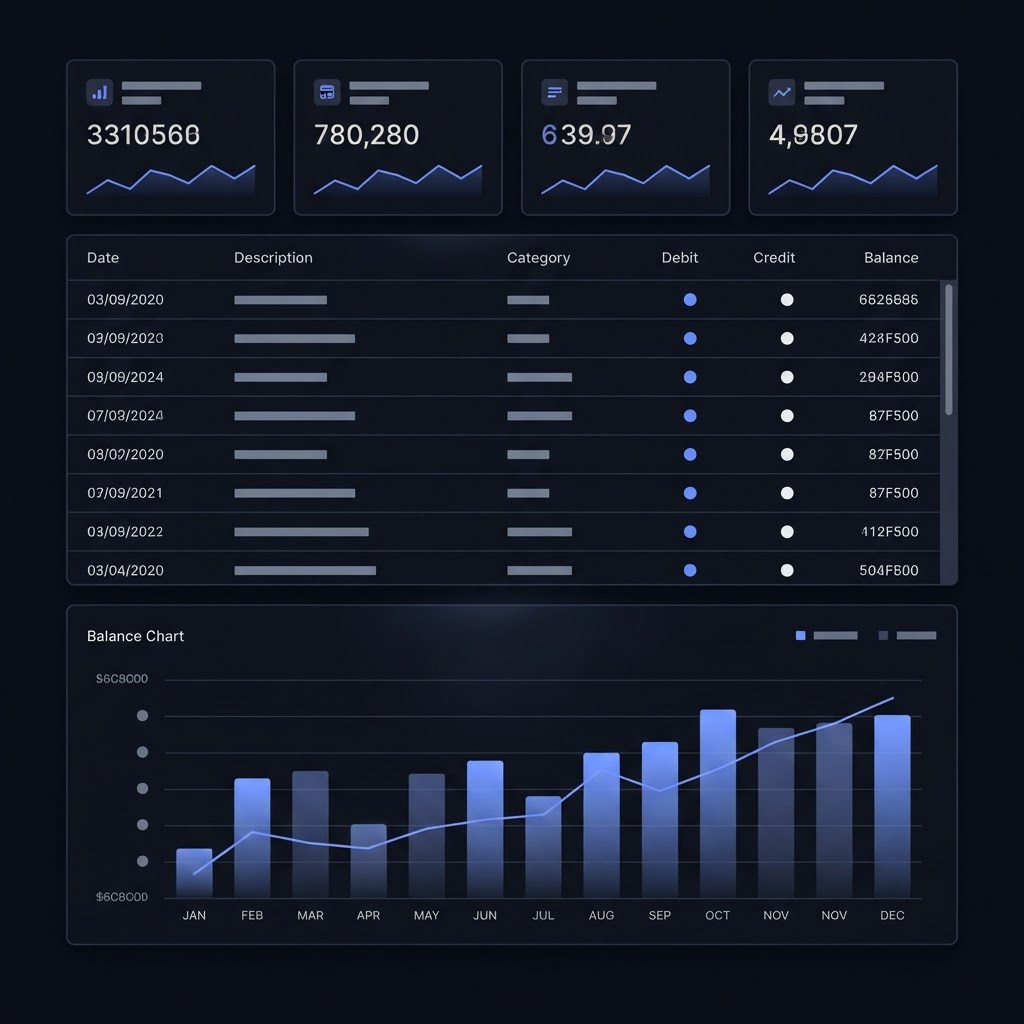
Overview
The Accounting App is a full-stack financial management application designed to replace manual bookkeeping with a structured, database-driven workflow. It provides a centralized system for recording financial transactions, organizing accounting data, and reviewing financial activity through a user-friendly interface.
The application combines a React frontend, a SQL-backed data layer, and authentication to support reliable data management and controlled access to financial records. Its primary focus is on data consistency, structured storage, and reducing the complexity of everyday bookkeeping.
Problem
Manual bookkeeping and spreadsheet-based accounting can make it difficult to track transactions, maintain accurate records, identify discrepancies, and retrieve historical financial information. As the volume of transactions grows, maintaining consistency and generating useful financial summaries becomes increasingly challenging.
Solution
I designed an accounting application that organizes financial information into structured database records and provides an interface for managing and reviewing that information. By using a relational SQL database, the application can represent relationships between financial records and apply database constraints to improve data integrity.
Key features
User Authentication
Authenticated access to the accounting application and its protected features.
Transaction Management
Create, view, update, and organize financial transaction records.
Structured Financial Records
Store transactions and related accounting entities in a relational database.
Transaction History
Retrieve and review historical financial activity using database queries.
Financial Summaries
Present transaction totals and categorized financial information where implemented.
Data Validation
Validate inputs and apply appropriate database constraints to reduce invalid or inconsistent records.
Persistent Storage
Maintain financial records in a SQL database instead of relying on temporary or manually maintained data.
Maintainable Architecture
Separate the user interface, business logic, and data-access responsibilities.
Implementation
The application uses React to build a responsive interface and SQL to manage persistent financial data. The relational database can organize entities such as users, transactions, accounts, and categories through primary keys, foreign keys, and appropriate constraints.
Authentication protects access to the application, while authorization determines which records and operations each user can access. Database queries support filtering, aggregation, and retrieval of transaction history.
For financial accuracy, monetary values should be stored using an appropriate fixed-precision decimal type rather than floating-point types. Related financial updates should use database transactions when multiple operations must succeed or fail together.
Challenges
- Designing a relational schema that represents financial data consistently.
- Maintaining data integrity across related records and operations.
- Writing SQL queries to retrieve transaction histories and calculate financial summaries.
- Handling authentication and protecting user-specific financial information.
- Separating presentation logic from business rules and database operations.
Outcome
The project demonstrates the ability to build data-driven business applications, design relational database structures, implement persistent CRUD workflows, and apply data-integrity principles to financial software.
Technologies
Demonstrates
Relational database design, SQL querying, CRUD operations, data integrity, and business-oriented application development.

